
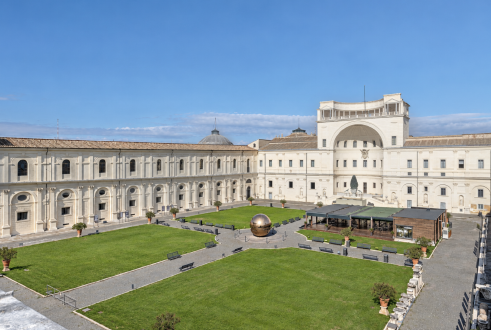
The Courtyard of the Pinecone: a rediscovered Renaissance gem
Vatican Museums
The Courtyard of the Pinecone, a true gem of Renaissance architecture, has regained its original colour. A decade-long restoration project, which began in September 2016 under the direction of the Vatican Museums, has restored its original travertine colour. Prior to the restoration, clear signs of deterioration were evident on the plasterwork and surfaces of the courtyard’s façades. Between 2015 and 2016, three experimental, or ‘pilot’, restoration projects were completed. The first pilot project (March 2015–July 2016) focused on the north-east corner of the Courtyard, the second (August 2015–September 2016) on the top terrace of the Nicchione, and finally the third (January 2016–November 2016) on the south-east corner.
The conservation and restoration work was carried out by the Vatican Museums’ Department of Architectural Heritage, with the active collaboration of numerous departments and laboratories of the Pope’s Museums: the Department of XV-XVI Century Art, the Department of XVII-XVIII Century Art, the Department of XIX Century and Contemporary Art, the Cabinet of Scientific Research, the Stone Materials Restoration Laboratory, the Paintings and Wood Materials Restoration Laboratory, and the Metals and Ceramics Restoration Laboratory.
Through stratigraphic studies and diagnostic analyses of the original constituent materials and subsequent accretions (superfetations), the building stratigraphy, general criteria for intervention, materials to be used and methodologies to be employed were defined in preparation for the launch of the major restoration and conservation project for the Courtyard of the Pinecone. The location of these three worksites was determined by the need to gather data relating to different construction phases. The numerous stratigraphic tests carried out revealed traces of the original ivory-coloured (or travertine-coloured) whitewash, composed of lime and marble dust, with no distinction whatsoever between architectural mouldings and masonry. From the nineteenth century onwards, in keeping with the customs of the time and Roman tradition, the façades were then painted yellow ochre.
The restoration carried out over the past ten years has aimed to restore the original colours of the surfaces, based also on fundamental archival research and numerous historical views that depict the complex at various stages of its history. It was therefore decided to proceed with the choice of travertine as the uniform colour for the architectural elements and masonry, using, as far as possible, traditional mixes that involved the use of lime putty, cow’s milk and powdered pigments. In this way, a finish was achieved that is chromatically very similar to that of the oldest fragments found.
The works concluded with general maintenance of the façades, and the restoration of the Portal of Gregory XV and Gio Ponti’s Marble Staircase. The restoration of the Portal of Gregory XV, situated in the north-east corner of the Courtyard of the Pinecone and providing access to a staircase leading to the Fontana della Galea (Fountain of the Galleon) and the avenue of the same name, gave rise to a genuine discovery. A few months after his election, Gregory XV Ludovisi (1621-1623) commissioned work on the staircase, instructing the masons to construct brick steps and the fine travertine portal overlooking the Courtyard of the Pinecone, on whose lintel the pope’s name is still visible today, revealed by the restoration.
In 1936, the Milanese architect and designer Gio Ponti intervened on the brick steps of the Staircase of Gregory XV, replacing them with polychrome marble to create the Marble Staircase, designed for the Universal Exhibition of the Catholic Press, which was staged in four pavilions in the Courtyard of the Pinecone. Distinguished by its elegant interplay of marble and alabaster, the staircase is now finally visible again.
The restoration was made possible thanks to the generous contribution of the Patrons of the Arts in the Vatican Museums. This constitutes the most extensive long-term restoration project undertaken by the Patrons.


