JULIUS II (1503-1513)
LEO X (1513-1521)
The beginnings of the Vatican Museums sculpture collection in the Octagonal Court

The beginnings of the Vatican Museums sculpture collection in the Octagonal Court
The Vatican Museums themselves were originally founded as collections of works of classical archaeology. The Popes viewed themselves as the legitimate heirs of Roman history. The pagan capital had turned Christian; the imperium of Augustus and Trajan was merged into the imperium sine fine of the Catholic and Apostolic Church. The monuments of the Roman civilisation therefore had to be preserved, safeguarded and revered ad maiorem Dei gloriam and for the honour and glory of the Church.
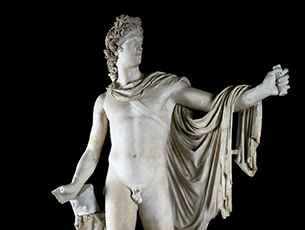
In 1506 the original nucleus of the Vatican Museums' classic works was set up in the Cortile delle Statue, today known as the Octagonal Court. Here Pope Julius II (della Rovere) displayed an impressive collection of ancient sculptures, including the Apollo Belvedere and the Laocoön which had just been rediscovered after centuries buried on Esquiline Hill.
It was also Julius II who in 1508 tasked Michelangelo Buonarroti with updating the decoration of the Sistine Chapel. The Chapel, originally called the Cappella Magna, got its new name when Pope Sixtus IV (della Rovere) (1471-1484) had it restored. Julius II inaugurated the Sistine Chapel with Michelangelo's splendid new ceiling at a Solemn High Mass on All Saints Day, 1 November 1512.
Julius II also commissioned the decoration of Raphael's Rooms. As the Pope did not want to live in the same rooms used by his predecessor, Alexander VI, he commissioned Raffaello Sanzio da Urbino to decorate certain rooms in a wing that Nicholas V had had built in the mid-fifteenth century. Pope Julius II gave Raphael free rein to create frescoes and artworks as he wished, a grand project which would continue under Pope Leo X (de' Medici) (1513-1521).
This section includes the Room of the Segnatura (1508-1511), the Room of Heliodorus (1511-1514), the Room of the Fire in the Borgo (1514-1517) and the Room of Constantine (1517-1524). The frescoes in this last room were painted mostly by Raphael's students; the master had died suddenly on 6 April 1520.
Meanwhile, in 1508 the architect Donato Bramante had begun work on the Loggia. On his death in 1514, Raphael was called upon to take over the project. Raphael, together with his students, also painted the frescoes on the second floor of the Loggia, and they are seen as his answer to his "rival" Michelangelo. As in the Sistine Chapel, the themes and subjects are for the most part drawn from the book of Genesis.
It was also Raphael whom Pope Leo X tasked with the decoration of the Room of the Chiaroscuri.