
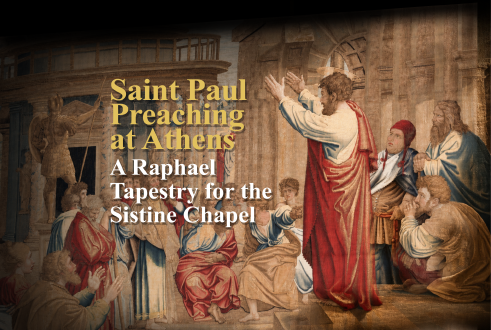
Saint Paul Preaching at Athens
A Rapahel Tapestry for the Sistine Chapel
Papal Palace of Castel Gandolfo (Rome)
From 4 August 2026, in the Papal Palace of Castel Gandolfo, the tapestry depicting the Saint Paul Preaching at Athens will be displayed in the Hall of the Popes. Part of the celebrated series of tapestries depicting the Acts of the Apostles commissioned by Pope Leo X (1513–1521) to decorate the walls of the Sistine Chapel, it was produced between 1515 and 1521 by a Flemish workshop based on preparatory cartoons by Raphael Sanzio (1483–1520) and his workshop.
The tapestry – exhibited under the curatorship of Alessandra Rodolfo, Director of the Vatican Museums’ Department of Tapestry and Textiles, and Michela Gianfranceschi, Assistant – depicts one of the most famous passages from the stories of Paul, taken from the book of the Acts of the Apostles. It shows the moment when Saint Paul, standing before the Areopagus in Athens, preaches the coming of the Lord. Saint Paul, the “Apostle of the Gentiles”, openly debating with the Athenian philosophers and men of law, thus spreads the new Christian message.
The scene conceived by Raphael, skilfully structured around figures and architectural elements, displays a solid perspective structure. Paul stands on the right, almost with his back to the viewer, yet still imposing and charismatic. The apostle’s physical features, combined with the gesture he makes, convey the full force of his faith and the overwhelming force of his reasoning. At the same height as the apostle, the gilded statue of Mars in armour stands out in the background, a symbol of the ancient religious beliefs that were about to be swept away by the new Christian message.
The tapestry has had a troubled history: documents show that it reached the Vatican by the end of 1521, and was then looted during the devastating Sack of Rome in 1527, only to be returned to the Pope in 1554 by the Constable of France, Anne de Montmorency, as evidenced by the coat of arms and the inscription at the bottom of the side frieze, which was altered before the tapestry’s return to the Vatican.
The episode depicted in the tapestry has great contemporary relevance today, in a world plagued by conflict and war, offering an example of profound and lively dialogue between different cultures.
Access to the exhibition is free of charge and included in the entrance ticket to the Papal Palace of Castel Gandolfo (which may be visited, either with a guide or independently, together with the Garden of the Moor and the Secret Garden).


