
Graecia capta in the epigraphic collections
A scientific and museographic “reconquest” and the updating of the corpus of the Inscriptiones Graecae XIV, 4 (Rome)
Vatican Museums Conference Hall – in person and live streaming
The next event in the Thursday in the Museums programme, on 19 November, entitled “Graecia capta in the epigraphic collections”, focuses on the Greek world, which has always been in dialogue with Rome. The Latin expression is intended as a metaphor for the body of Greek-language inscriptions “contained” within the museum collections. “Contained” or “conquered” by the Holy See, if we wish to remain more faithful to the meaning of the verb in the famous Horatian verse from which it is taken: Graecia capta ferum victorem cepit, “Greece, conquered (by the Romans), conquered the savage victor”.
These inscriptions have now been “reconquered”, thanks to the scientific and museographic research carried out by Rosanna Barbera, Curator of the Department of Epigraphic Collections, with the support of the Directorate of the Museums and in collaboration with the Stone Materials Restoration Laboratory, as well as the “Maintenance” and “Control and Security” Offices.
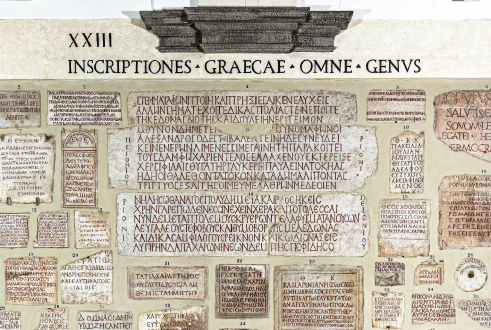
The starting point is the Lapidary Gallery, in particular walls XXII and IB, where the Inscriptiones Graecae omne genus – “Greek inscriptions of all kinds” – are displayed, as stated in the nineteenth-century captions painted above them. This research forms part of a major scientific project promoted by the Berlin-Brandenburgische Akademie der Wissenschaften (Berlin-Brandenburg Academy of Sciences and Humanities) and supported by Italian and foreign institutions, namely universities, museums and heritage bodies: the new edition of Volume XIV of the nineteenth-century corpus of the Inscriptiones Graecae.
The Vatican Museums’ contribution is currently focused on updating the fascicle containing the Greek inscriptions from Rome (IG XIV² 4), a project coordinated by Daniela Summa, a researcher at the aforementioned Berlin Academy and project leader, together with Francesco Camia, Professor of Greek Epigraphy at Sapienza University of Rome.
Introduced by the Director of the Vatican Museums, Barbara Jatta, the two scholars will speak at the conference, presenting the research project to “specialists” and lay enthusiasts alike: they will also demonstrate to the general public how the Greek inscriptions of Rome are fundamental historical sources for understanding the presence, influence and role of Greek culture in Roman society. Rosanna Barbera, on the other hand, will report on her own research, carried out as part of the restoration work on the “pilot” site of Wall XLVII, which was presented at Thursday in the Museums in November 2025.


