
The Light of Christmas
The Barberini Nativity
Papal Palace of Castel Gandolfo (Rome)
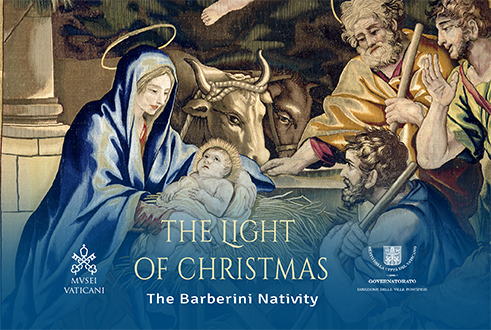
A magnificent seventeenth-century tapestry, the Nativity, produced by the Barberini workshop, is the work chosen by the Vatican Museums and the Directorate of the Pontifical Villas to celebrate the upcoming Christmas festivities. The tapestry was commissioned in 1635 by Pope Urban VIII from the Barberini tapestry workshop for the “papal chapel”, most likely the Sistine Chapel. Intended to be displayed behind the altar as the backdrop to the papal baldachin, it was accompanied by six tapestry pendants. The weaving of the Nativity tapestry began in September 1635 and was completed in February 1636 under the direction of Giacomo della Riviera, with the work carried out by the tapestry weavers Michael the Flemish and Anthony the French.
The papal inventories describe the cloth “with gold, silk and worsted”, confirming the use of metallic threads, silk and wool, and attribute the design to the “Cortonese”, that is, Pietro da Cortona, one of the leading figures of Roman Baroque painting. The composition depicts the Adoration of the Shepherds, with the Virgin presenting the Child lying in the manger, while Saint Joseph and the shepherds gather around Him. Above the scene, angels hold a scroll bearing the words “Gloria in excelsis Deo”, taken from the angels’ song in the Gospel of Luke (2:14) and repeated in the Gloria of the Mass.
In its original position behind the altar, the image thus linked the proclamation of Christ’s birth with the liturgical celebration. The Nativity was joined by the Resurrection in 1642 and the Pasce oves meas in 1643, both woven for Urban VIII based on designs by Giovan Francesco Romanelli. The three tapestries were intended to be displayed in rotation behind the altar in accordance with the liturgical occasions.
The presentation of the tapestry at Castel Gandolfo, on the occaion of Christmas, invites visitors to contemplate the mystery of the Saviour’s birth through a precious woven image that once accompanied the prayers and celebrations in the pontifical chapel.
Access to the exhibition is free of charge and included in the entrance ticket to the Papal Palace of Castel Gandolfo (which may be visited, either with a guide or independently, together with the Garden of the Moor and the Secret Garden).